


Page 35 - focusUnimore_settembre2021
P. 35
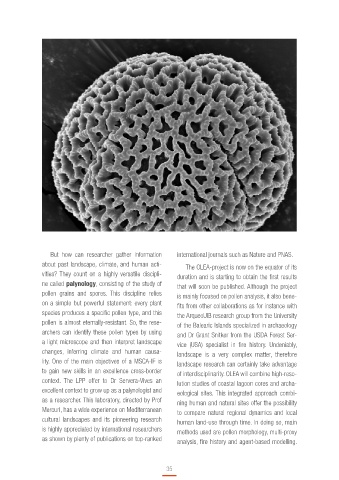
But how can researcher gather information   international journals such as Nature and PNAS.
                about past landscape, climate, and human acti-    The OLEA-project is now on the equator of its
                vities? They count on a highly versatile discipli-  duration and is starting to obtain the first results
                ne called palynology, consisting of the study of   that will soon be published. Although the project
                pollen grains and spores.  This discipline relies   is mainly focused on pollen analysis, it also bene-

                on a simple but powerful statement: every plant   fits from other collaborations as for instance with
                species produces a specific pollen type, and this   the ArqueoUIB research group from the University
                pollen is almost eternally-resistant. So, the rese-  of the Balearic Islands specialized in archaeology
                archers can identify these pollen types by using   and Dr Grant Snitker from the USDA Forest Ser-
                a light microscope and then interpret landscape   vice (USA) specialist in fire history. Undeniably,
                changes, inferring climate and human causa-    landscape is a very complex matter, therefore
                lity. One of the main objectives of a MSCA-IF is   landscape research can certainly take advantage
                to gain new skills in an excellence cross-border   of interdisciplinarity. OLEA will combine high-reso-
                context.  The LPP offer to Dr Servera-Vives an   lution studies of coastal lagoon cores and archa-

                excellent context to grow up as a palynologist and   eological sites. This integrated approach combi-
                as a researcher. This laboratory, directed by Prof   ning human and natural sites offer the possibility
                Mercuri, has a wide experience on Mediterranean   to compare natural regional dynamics and local
                cultural landscapes and its pioneering research   human land-use through time. In doing so, main
                is highly appreciated by international researchers   methods used are pollen morphology, multi-proxy
                as shown by plenty of publications on top-ranked   analysis, fire history and agent-based modelling.


                                                           35

